Is Magic Win Casino Safe? Reviews, Complaints & Reputation
 Available in US
Current public reputation signals for Magic Win are strongly negative. On 27 August 2026, Trustpilot showed a 1.3/5 score from 289 reviews, with 93% of reviews at one star. Casino Guru’s current Magic Win review showed a Safety Index of 0.6/10, labelled “Very low”, together with 135 complaints in its complaint table, including 94 unresolved cases. Recent public complaints repeatedly focus on withdrawals and support responses.
Those signals matter, but they need careful interpretation. A poor review score is not a legal finding, and an individual customer’s allegation is not proof that every withdrawal will fail. The useful conclusion is narrower: the volume, recency and similarity of independent complaints create a serious reputation risk that deserves more weight than headline game counts, bonuses or site design. Licence status is a separate evidence question, covered in the licence and safety guide.
Table of Contents
- Magic Win reputation snapshot: 27 August 2026
- What recent complaints are mainly about
- A practical evidence hierarchy
- What the reputation evidence can prove
- What the evidence cannot prove
- Why recency matters more than an old average
- How to read withdrawal complaints without overreacting
- Five checks before treating a casino as low risk
- Reputation versus bonus, games and payment choice
- If self-exclusion or loss of control is part of the concern
- Bottom line
Magic Win reputation snapshot: 27 August 2026
The most useful reputation data is time-sensitive, so this page records the date of the check rather than presenting ratings as permanent facts. Trustpilot’s Magic Win Casino profile displayed a TrustScore of 1.3 out of 5 from 289 reviews when checked on 27 August 2026. Its distribution showed 93% one-star reviews, while five-star and four-star reviews each represented 2%.
Casino Guru’s current review gave Magic Win a Safety Index of 0.6/10 and classified it as “Very low”. The complaint section listed 135 total complaints: 94 unresolved, 8 resolved and 33 rejected. Casino Guru also stated that the casino does not cooperate with its complaint specialists on submitted cases. That last point is Casino Guru’s assessment of its own mediation experience, not a regulator ruling.
These two platforms use different methods. Trustpilot is an aggregate customer-review platform. Casino Guru combines editorial assessment, terms analysis and its own complaint-resolution database. Agreement between them does not make every allegation true, but it does strengthen the conclusion that Magic Win has a substantial current reputation problem rather than one isolated negative review.
What recent complaints are mainly about
The strongest recurring theme is withdrawal delay. Recent Trustpilot reviews from UK users repeatedly allege withdrawals remaining pending for weeks or months, with customers saying they received generic or repetitive status messages. Casino Guru’s complaint database shows the same broad theme in multiple recent cases, including complaints about delayed withdrawals that were closed as unresolved after the operator did not engage with its mediation process.
Support is the second recurring theme. Reviewers often describe difficulty getting a specific answer, reaching a human decision-maker or obtaining a clear escalation route. Some reviews use words such as “scam” or make wider accusations. This page does not repeat those labels as facts. They remain the reviewers’ allegations. The verified fact is that complaint platforms contain a high concentration of negative reports about payout delays and support quality.
There are also complaints about account access, account closure or self-exclusion requests. These are relevant because they indicate that the reputation issue is not limited to one narrow payment-method problem. Still, an individual complaint can have missing context, may later be resolved, or may involve facts that an outside reader cannot independently verify. That is why the page focuses on patterns and platform-level outcomes rather than treating one story as definitive evidence.
A practical evidence hierarchy
Not all safety evidence should carry the same weight. For Magic Win, a useful order is:
- Regulator records. A licence register answers whether a regulator has granted an operating licence to a named business. It does not answer whether customers like the service, but it is the highest-value source for licence status.
- Independent complaint-resolution records. These show whether recurring disputes exist and whether an operator engages with an external mediation process. They are still not court judgments.
- Aggregate customer-review data. A large, current group of similar reports can identify recurring service risks, especially when the pattern persists across months.
- Individual user stories. These can be useful examples but should be treated as allegations unless independently substantiated.
- Operator marketing claims. Game counts, bonuses and promotional copy describe the product but do not resolve payout or complaint risk.
This hierarchy prevents two common mistakes. The first is dismissing hundreds of complaints because a casino has a large game library. The second is declaring fraud because of one angry review. Neither approach is evidence-led.
What the reputation evidence can prove
The evidence supports several concrete conclusions. Magic Win has a very poor current Trustpilot score. Casino Guru assigns it a very low Safety Index and records a high number of unresolved complaints. Withdrawal delays and support frustration recur across independent sources. Those are fair, attributable reputation facts.
The evidence also supports a decision-making conclusion: a prospective customer should treat withdrawals and dispute handling as a material risk area and should investigate those issues before depositing. If access to money is your main concern, read the separate withdrawal complaints guide, which keeps payout mechanics and unsupported timing claims separate from reputation data.
The complaint pattern also makes it reasonable to demand stronger proof before relying on marketing claims about convenience. A smooth cashier interface or a large payment list does not answer whether disputed withdrawals are resolved effectively. The payments guide covers supported banking categories, while this page asks a different question: what does the public record say about the operator’s treatment of complaints?
What the evidence cannot prove
Review platforms cannot establish a criminal or civil finding. They do not prove that every complaint is accurate, that every customer experiences the same problem or that every future withdrawal will be delayed. A Trustpilot score is not a regulator decision. A Casino Guru Safety Index is an editorial metric produced by Casino Guru, not an official government rating.
Reputation evidence cannot substitute for licence verification. Licence status comes from regulator records, not review scores, while complaint data does not determine whether an operator holds a licence in another jurisdiction. These evidence tracks should stay separate.
Finally, user allegations should not be converted into precise operational facts. A reviewer saying a withdrawal took a certain number of days does not establish the casino’s official processing time. Exact withdrawal limits, fees and method-specific processing times remain high-risk details and are not published here without direct current operator terms.
Why recency matters more than an old average
A reputation page becomes misleading if it freezes an old score while complaints continue to arrive. Trustpilot had recent Magic Win reviews dated in July and August 2026. Casino Guru also had recent complaint cases, including a new UK withdrawal complaint submitted on 26 August 2026. The pattern is therefore current, not merely a historical pattern from the casino’s launch period.
That recency is more important than quoting one dramatic story. A prospective player should look at the newest few months, then compare those reports with older periods. If complaints are concentrated in a short-lived incident and then disappear, the interpretation can change. If the same complaint theme continues across a long period, the persistence itself becomes useful evidence.
For publication, the ratings and counts on this page should be rechecked again if the page is not published promptly. The conclusion can stay evidence-based only when the dated numbers remain tied to the date they were observed.
How to read withdrawal complaints without overreacting
Withdrawal complaints deserve attention because they concern access to customer funds, but they also require context. A delay can arise from identity verification, payment ownership checks, bonus review or operator processing. The important question is not whether any delay exists, but whether the operator communicates a clear reason, follows its stated process and provides a functioning escalation route.
Magic Win’s current reputation problem is that many public complaints allege prolonged delays combined with repetitive or non-specific support responses. Casino Guru’s unresolved-case pattern adds another layer because its complaint team reports that the operator has not cooperated with mediation attempts. That combination is more informative than one customer simply saying a payout was slower than expected.
It is still wrong to convert the pattern into a guarantee that a particular user will not be paid. The practical response is to reduce uncertainty before depositing: verify licence status, read current withdrawal terms, avoid assuming a promotional balance is immediately withdrawable and keep records of transactions and support conversations.
Five checks before treating a casino as low risk
- Verify the licence independently. Use the regulator’s own register rather than a logo or affiliate claim. For Magic Win, see the UKGC status analysis.
- Check complaint recency. Look at the newest complaints, not only the lifetime rating.
- Separate resolved from unresolved cases. A platform with many complaints but effective resolution is different from one with a large unresolved backlog.
- Read the withdrawal terms before depositing. Do not rely on remembered figures from an old review, especially for limits, fees and processing windows.
- Know your escalation options. Understand what support channel exists and what external dispute route is actually available under the operator’s verified licence position.
These checks do not remove risk, but they make the decision less dependent on marketing or isolated anecdotes.
Reputation versus bonus, games and payment choice
Magic Win is reviewed elsewhere on this site for bonuses, games and banking. Those product features can be real and still coexist with negative reputation evidence. The guide’s licence-isolation and fact-isolation rules matter here: a complaint signal does not automatically make a payment-method fact false, and a verified game provider does not make payout complaints irrelevant.
The correct approach is to ask different sources different questions. Product sources answer what is offered. Regulator records answer licensing. Complaint platforms answer how users and mediators describe service outcomes. Combining them is useful only after keeping those roles clear.
This is also why the headline question “is Magic Win safe?” does not have a useful one-word answer. The strongest current evidence points to material reputation risk, particularly around withdrawals and support, while the formal licence analysis remains a separate check.
If self-exclusion or loss of control is part of the concern
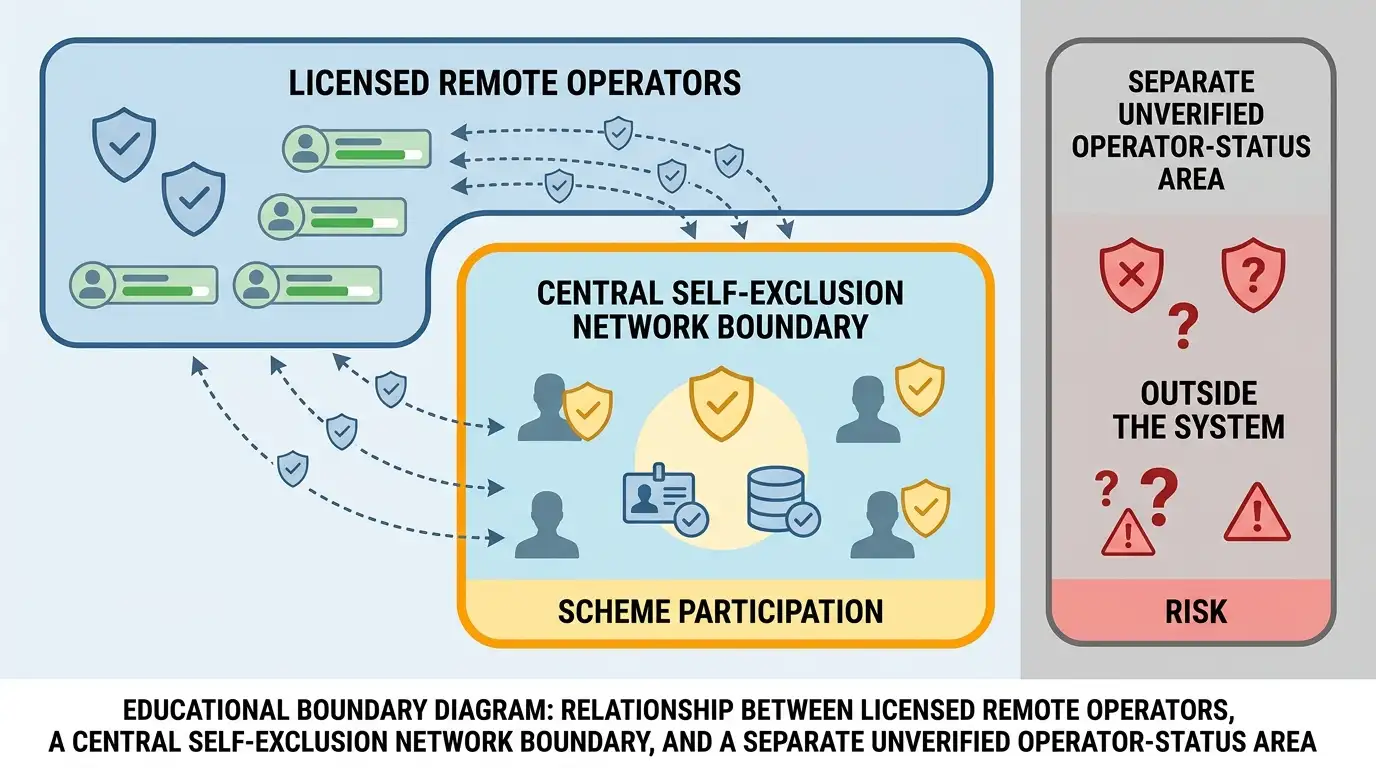
Reputation checks should not become a reason to move from one operator to another if gambling itself is causing harm. For UK readers, GAMSTOP is the national online self-exclusion scheme for licensed gambling websites and apps. The separate GamStop status guide explains the current scheme boundary without presenting offshore access as a workaround.
If you have already chosen to self-exclude, the safer decision is to maintain that barrier rather than search for sites outside it. Product comparison is not a substitute for support.
Bottom line
As of 27 August 2026, Magic Win’s public reputation record is materially negative. Trustpilot shows 1.3/5 from 289 reviews with 93% one-star. Casino Guru gives a 0.6/10 Safety Index and lists 135 complaints in total, including 94 unresolved. Repeated reports about delayed withdrawals and weak support escalation appear across both sources.
That evidence is strong enough to justify caution and deeper checks, but not to support a legal label such as “scam”. The best decision is evidence-led: verify the licence, inspect the newest complaint trend, read current withdrawal terms and decide whether the unresolved-risk profile is acceptable before putting money at risk.
For the wider product context, return to the Magic Win review.
Published by the Magicwin Casino team.